Why Does Climbing Stairs Make My Back Pain Worse? 10 Reasons And How To Make Stairs Easier
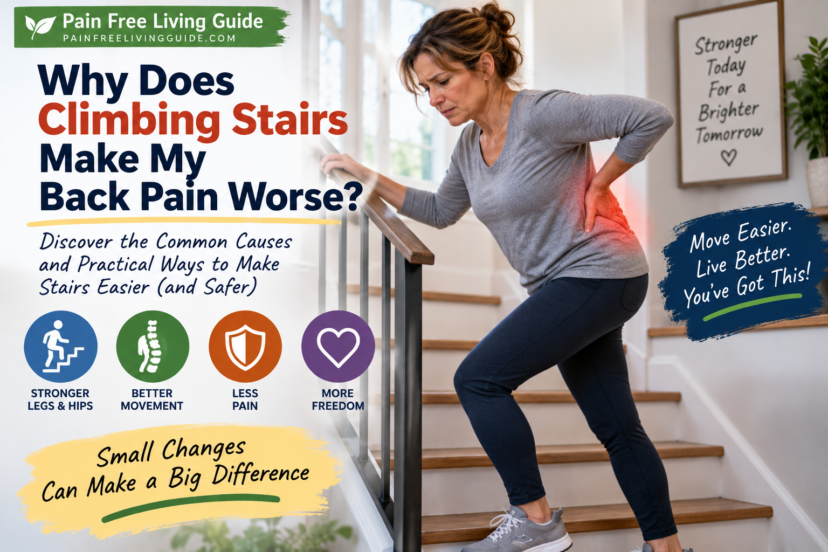
When you already live with back pain, a staircase can feel much harder than it used to. You may manage walking on level ground fairly well, yet feel aching, stiffness, or increased discomfort as soon as you start going upstairs. If you’re wondering why does climbing stairs make my back pain worse, the answer often involves the extra strength, balance, joint movement, and muscle control required to lift your body from one step to the next.
That’s important because avoiding stairs isn’t realistic for everyone. Your bedroom may be upstairs. You may have steps at work, in an apartment building, or at the entrance to your home.
Instead of giving up an important everyday activity, the goal is to understand what makes stairs challenging and find practical ways to reduce unnecessary strain, improve strength, and move with greater confidence.
🪜 Quick Answer: Why Does Climbing Stairs Make My Back Pain Worse?
Climbing stairs may make back pain worse because each step requires greater effort from your legs, hips, core, and back than level walking. Weak or fatigued muscles, reduced hip mobility, poor balance, taking steps too quickly, and existing back sensitivity can increase discomfort. Using the handrail, slowing down, taking controlled steps, and gradually strengthening your legs, hips, and trunk can make stairs easier.
Key Takeaways
Most likely cause: Stairs require more muscular effort, balance, hip and knee movement, and trunk control than level walking, which can aggravate an already sensitive lower back.
Usually serious? Usually not by itself. Increased discomfort with stairs can occur with many common back and mobility problems. Severe, progressive, or neurologic symptoms should be medically evaluated.
First thing to check: Notice whether you’re rushing, leaning heavily forward, avoiding one leg, carrying objects, or experiencing weakness, stiffness, or balance problems while climbing.
Best solution: If you’re asking why does climbing stairs make my back pain worse, make unavoidable stairs easier by using the handrail, slowing your pace, reducing what you carry, and gradually improving leg, hip, and trunk strength.
🔍 Why Stairs Can Feel Harder Than Regular Walking
Walking across a room and climbing a staircase aren’t the same physical task.
When you walk on level ground, your body moves mostly forward. When climbing stairs, you must repeatedly raise your body against gravity.
Your hip and knee bend more, your muscles must produce greater force, and your trunk helps control your position as you transfer weight onto one leg.
If you’re already experiencing lower back pain, this extra demand can expose limitations you barely notice during ordinary walking.
The problem isn’t necessarily that stairs are damaging your spine.
They may simply demand more than your current comfortable physical capacity.
🦵 1. Your Legs And Hips Have To Work Harder
Every upward step requires your leg muscles to help lift your body.
Your quadriceps, gluteal muscles, calves, hips, and trunk all contribute to stair climbing. If some of these muscles are weak or fatigued, other areas may have to work harder.
That can include your lower back.
This becomes particularly relevant with aging because muscle strength can decline when people become less active. Chronic pain can accelerate the problem indirectly if it causes you to avoid stairs, walking, exercise, and other physical activities.
Gradual strengthening can help make everyday movement less demanding.
🧩 2. Limited Hip Mobility Can Change How You Climb
Your hips need to move comfortably when stepping upward.
If hip movement feels restricted, you may compensate by leaning your trunk, rotating your body, or using momentum to reach the next step.
Those compensations aren’t automatically harmful, but they may increase discomfort in an already sensitive back.
If you’re wondering why does climbing stairs make my back pain worse while other activities don’t, pay attention to whether one hip feels particularly stiff or whether you consistently turn your body while climbing.
A physical therapist can assess whether hip mobility, strength, or another movement limitation is contributing.
💪 3. Weak Glutes Can Make Stairs More Demanding
Your gluteal muscles are important for extending your hip and controlling your body during walking, standing, and stair climbing.
When these muscles don’t have enough strength or endurance for the task, climbing may feel considerably harder.
Exercises such as bridges, sit-to-stands, and appropriately selected step-ups can help build strength.
You don’t need an intense gym routine.
For many adults, improving the ability to repeatedly stand from a chair with good control is already useful functional training for daily life.
🧠 4. Pain Can Change The Way You Move
When something hurts, your body naturally tries to protect it.
You might climb stairs more stiffly, shorten your steps, hold your breath, shift your weight away from one side, or grip the handrail tightly.
These changes can sometimes make movement more tiring.
Fear also matters. If you’ve previously experienced a sharp increase in pain on the stairs, you may anticipate that it will happen again.
That doesn’t mean the pain is imaginary.
It means pain can influence both how you feel and how you move.
Learning comfortable movement strategies and gradually rebuilding confidence can therefore be part of recovery.
🪜 5. Taking Stairs Too Quickly Can Increase Strain
Stairs aren’t a race.
Moving quickly requires your muscles to produce force faster and gives you less time to control each step.
When living with existing back pain, slow and deliberate movement may feel more comfortable.
Try:
- Place Your Entire Foot Securely On The Step
- Use The Handrail When Available
- Keep Your Movements Smooth
- Avoid Rushing
- Pause Safely If You Need A Break
A slower pace can also reduce fatigue when you need to climb several flights.
🛍️ 6. Carrying Things Makes Stairs Harder
A laundry basket changes stair climbing considerably.
So do grocery bags, luggage, packages, tools, and other household items.
The added weight increases physical demand, while carrying bulky objects can prevent you from using the handrail or seeing the steps clearly.
When possible, make shorter trips instead of carrying one large load.
A backpack may be useful for some lightweight items because it can leave your hands available, although the load should remain manageable.
If carrying something makes you feel unstable or significantly increases your pain, ask for help.
Preventing a fall matters more than saving an extra trip.
🧍 7. Leaning Too Far Forward May Feel Uncomfortable
Some forward trunk lean naturally occurs during stair climbing.
But when stairs feel difficult, people sometimes bend farther forward to help generate momentum.
If this increases your symptoms, experiment with staying more comfortably upright rather than forcing yourself into either an exaggerated forward lean or a rigid posture.
Use the handrail for support and let your legs do as much of the work as they comfortably can.
There isn’t one perfect stair-climbing posture for everyone.
The goal is controlled, confident movement.
🔄 8. Fatigue Can Make Back Pain Worse On Stairs
Your experience on the stairs at 8 a.m. may be different from 6 p.m.
After a day of working, sitting, standing, walking, driving, and doing household tasks, your muscles may already be fatigued.
Stairs then add another relatively demanding activity.
This helps explain why climbing stairs may make back pain worse near the end of a busy day.
Try pacing demanding activities throughout the day instead of completing everything at once.
If possible, combine trips upstairs so you’re not unnecessarily climbing the same staircase repeatedly—but don’t carry an unsafe load just to save a trip.
🚶 9. Avoiding Stairs Completely Can Reduce Your Capacity
When stairs hurt, avoiding them seems logical.
Sometimes temporarily reducing an aggravating activity is appropriate. But long-term avoidance can have an unwanted consequence: you may lose some of the strength and confidence required to climb stairs.
Then the next staircase feels even harder.
For many people with uncomplicated back pain, a better long-term goal is gradually rebuilding tolerance.
That might mean climbing one flight slowly instead of several, using the handrail, resting when needed, and gradually increasing activity as your capacity improves.
The objective isn’t to push through severe pain.
It’s to find a manageable level of activity and build from there.
🏋️ 10. Strengthening Can Make Everyday Stairs Easier
If stairs are unavoidable, training for them makes practical sense.
Useful exercises may include:
Sit-To-Stands
Sit in a stable chair and stand using controlled movement, then slowly sit again.
This strengthens muscles needed for getting out of chairs and climbing stairs.
Step-Ups
When appropriate and safe, controlled step-ups onto a low step can closely resemble stair climbing.
Use stable support and begin with a manageable height.
Bridges
Bridges can strengthen the hips and surrounding muscles while requiring little equipment.
Calf Raises
Strong calf muscles contribute to walking and stair movement.
Walking
Regular walking helps maintain general endurance so everyday activities require less effort.
A physical therapist can modify these exercises if arthritis, balance problems, previous surgery, chronic back pain, or other conditions make standard exercises difficult.
🌿 Simple Ways To Make Unavoidable Stairs More Comfortable
When you have to use stairs every day, small changes matter.
Try the comfort-first approach:
- Use A Secure Handrail
- Slow Your Pace
- Wear Supportive, Secure Footwear
- Keep Stairways Well Lit
- Keep Steps Free Of Clutter
- Avoid Carrying Unnecessarily Heavy Loads
- Take Smaller Trips When Needed
- Pause Safely Between Flights
- Stay Consistently Active Between Flare-Ups
For temporary muscle soreness, some people also find a warm shower or heating pad comfortable after a demanding day. Follow heating-product safety instructions and avoid sleeping with a heating pad.
These strategies aren’t intended to “cure” back pain. They’re ways to make an unavoidable part of life more manageable.
🩺 How Physical Therapy Can Help With Stairs
Physical therapy can be especially useful when back pain gets worse climbing stairs because stair climbing involves several physical abilities at once.
A physical therapist can evaluate your leg and hip strength, balance, trunk control, mobility, walking pattern, and the way you actually climb stairs.
Treatment may include strengthening, mobility work, balance exercises, step training, activity pacing, and gradual exposure to movements you’ve started avoiding.
This individualized approach can be more useful than simply being told to “strengthen your core.”
The goal is functional: making your real-world stairs safer, easier, and more comfortable.
🚨 When To See A Doctor
Back pain triggered by stairs isn’t automatically a warning sign, but certain symptoms require professional evaluation.
Contact a healthcare professional if your pain is severe, progressively worsening, persists despite reasonable self-care, or significantly interferes with walking and normal daily activities.
You should also seek evaluation if stair climbing causes significant leg weakness, persistent numbness or tingling, unusual balance problems, or pain that repeatedly travels down the leg.
Seek urgent medical care for new loss of bowel or bladder control, numbness around the groin or saddle region, severe or rapidly worsening leg weakness, or other major neurologic symptoms.
Back pain following significant trauma or accompanied by fever or unexplained weight loss also deserves medical attention.
❓ Frequently Asked Questions
Why Does My Lower Back Hurt When I Walk Up Stairs?
Walking upstairs requires more effort from your legs, hips, and trunk than walking on level ground. Weakness, fatigue, reduced mobility, or an already sensitive back can make this increased demand uncomfortable.
Is Climbing Stairs Bad For Lower Back Pain?
Not necessarily. Stairs can aggravate some people’s symptoms, but discomfort doesn’t automatically mean stair climbing is damaging the spine. Your individual condition and symptoms matter.
Should I Avoid Stairs If I Have Back Pain?
Complete long-term avoidance isn’t always necessary. If stairs are safe for you, modifying how you climb and gradually improving your strength may be more practical. Severe symptoms or significant weakness should be medically evaluated.
Why Is Going Upstairs Harder Than Walking?
Going upstairs requires you to repeatedly raise your body against gravity. That generally demands more from the muscles of your legs and hips than level walking.
Should I Use The Handrail When My Back Hurts?
Yes, especially if the handrail improves your balance and confidence. A secure handrail can provide additional support and help you control your pace.
What Exercises Help With Back Pain On Stairs?
Depending on your condition, exercises such as sit-to-stands, bridges, controlled step-ups, calf raises, walking, and other leg and hip strengthening may help improve stair-climbing capacity.
Why Does My Back Hurt More Going Up Stairs Than Down?
Going upstairs typically requires substantial muscle effort to lift your body against gravity. Going downstairs creates different demands involving balance and controlled lowering. Either direction can be uncomfortable depending on your individual back, hip, knee, strength, and mobility issues.
🌅 Conclusion: Make Stairs Easier Instead Of Letting Them Control Your Day
If you’ve been wondering why does climbing stairs make my back pain worse, remember that a staircase asks more from your body than ordinary level walking.
Your legs must lift you. Your hips need to move. Your trunk helps stabilize you. Your balance system controls each weight shift. When you’re already living with pain, weakness, stiffness, or fatigue can make those demands much more noticeable.
But the answer isn’t necessarily to eliminate stairs from your life.
Start by making the stairs you have to use easier.
Use the handrail. Slow down. Reduce heavy carrying. Improve lighting and safety. Build your leg and hip strength gradually. Pace yourself on tiring days.
Most importantly, give yourself time.
Strength, endurance, movement confidence, and activity tolerance develop through consistent practice—not one difficult workout. Small improvements can make getting around your home, visiting family, traveling, working, and staying active feel more manageable.
The goal isn’t perfect, pain-free movement every time you see a staircase. It’s greater comfort, confidence, mobility, and independence in the life you’re already living.
Medical Disclaimer: This article is for general educational and informational purposes only and isn’t a substitute for professional medical advice, diagnosis, or treatment. Back pain can have many causes. Consult a qualified healthcare professional for persistent, severe, worsening, or unexplained symptoms and before starting a new exercise, supplement, or treatment program.
 Explore more:
- Dehydration And Joint Pain: Can Not Drinking
- Stretching Routine For Stiff Muscles: 10 Simple
- Why Does Going Downstairs Hurt My Back?