Why Does Going Downstairs Hurt My Back? 10 Common Reasons And How To Make Every Step Easier
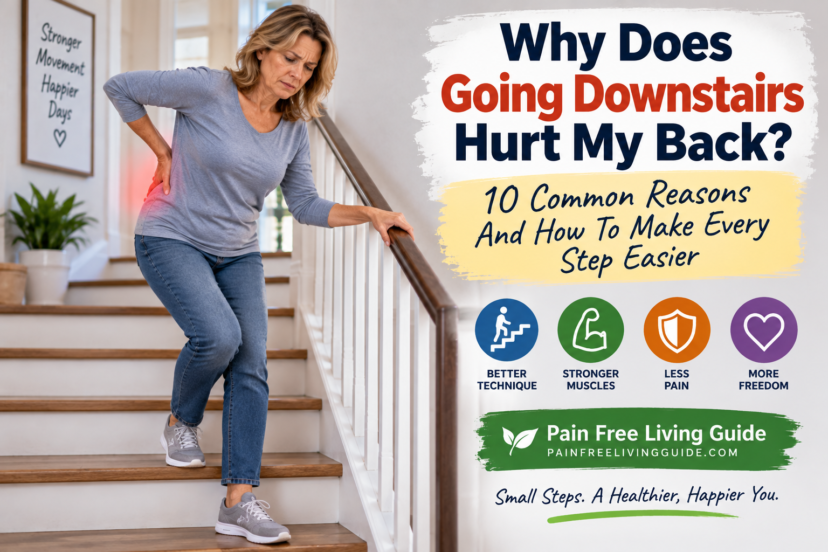
Walking downstairs looks simple until your back starts hurting with every step. If you’re wondering why does going downstairs hurt my back, the answer may involve the way your muscles control your body as you lower yourself from one step to the next. Descending stairs requires balance, leg strength, hip and knee control, and coordination through your trunk—and existing back pain can make those demands much more noticeable.
For adults living with chronic pain, stairs can become an unavoidable daily trigger. You may have steps between floors at home, stairs at work, or a front porch you use several times a day. Avoiding them completely isn’t always realistic.
Fortunately, discomfort doesn’t automatically mean every step is damaging your back. Slowing down, using the handrail, improving strength and balance, and changing a few everyday habits may make descending stairs safer and more comfortable.
🪜 Quick Answer: Why Does Going Downstairs Hurt My Back?
Going downstairs can hurt your back because your legs, hips, and trunk must control your body as you lower your weight onto each step. Existing back sensitivity, muscle weakness, fatigue, reduced mobility, balance problems, or moving too quickly can increase discomfort. Using the handrail, taking controlled steps, reducing heavy loads, and gradually strengthening your legs and hips may help.
Key Takeaways
Most likely cause: Descending stairs requires controlled lowering, balance, leg and hip strength, and trunk stability, which can aggravate an already sensitive or fatigued lower back.
Usually serious? Usually not by itself. However, severe or progressive pain, significant weakness, numbness, repeated falls, or other neurologic symptoms should be medically evaluated.
First thing to check: Notice whether you rush downstairs, lean excessively, land heavily, avoid one leg, carry objects, or feel weakness or instability while descending.
Best solution: If you’re wondering why does going downstairs hurt my back, start by slowing down, using the handrail, taking controlled steps, reducing what you carry, and gradually improving leg, hip, and trunk strength.
🔍 Why Going Downstairs Is Different From Walking On Flat Ground
Descending stairs requires your body to control gravity rather than simply move forward.
Each time you lower yourself to the next step, muscles in your legs and hips work to control the descent. Your trunk also helps maintain balance as your weight shifts from one leg to another.
That can expose limitations you don’t notice while walking across a level floor.
If your muscles are weak or fatigued, your joints are stiff, or your back is already sensitive, you may compensate by moving differently.
You might lean, twist, grip the rail tightly, or land harder than usual.
The key point is that pain during stair descent doesn’t automatically mean the stairs are injuring your spine. They may simply be exposing a movement your body currently finds demanding.
🦵 1. Your Muscles Must Control Your Descent
Going downstairs isn’t passive.
Your leg muscles work while lengthening under load to prevent you from simply dropping onto the next step. This controlled lowering is sometimes called an eccentric muscle action.
Your quadriceps are particularly important, while your hips, calves, and trunk also contribute.
If your legs lack sufficient strength or endurance, controlling each step may require more effort.
Your movement can then become less smooth, potentially increasing discomfort in an already sensitive lower back.
This is why improving lower-body strength can be useful even when the painful area is your back.
💪 2. Weak Hips And Legs Can Make Your Back Work Harder
When people ask why does going downstairs hurt my back, they often assume the problem must be entirely in the spine.
But movement involves your whole body.
Strong legs and hips help control your weight as you descend. If these areas aren’t contributing effectively, you may compensate with altered trunk movement or rely heavily on the handrail.
This can happen after periods of inactivity, illness, injury, or simply because chronic pain has caused you to move less.
Gradually rebuilding leg and hip strength may make the entire movement feel easier.
Useful exercises can include sit-to-stands, bridges, calf raises, and appropriately selected step exercises.
🧍 3. Leaning Or Twisting May Increase Discomfort
When you’re nervous about descending stairs, you may stiffen your body.
Some people turn slightly sideways. Others lean far forward or keep their trunk unusually rigid.
These aren’t automatically dangerous movements. However, if a particular strategy consistently increases your symptoms, experimenting with a more comfortable position may help.
Use the handrail, look where you’re stepping, and let your hips and knees move naturally.
Don’t try to maintain an exaggerated “perfect” posture.
Your goal is controlled, confident movement rather than keeping your spine completely motionless.
👣 4. Heavy Landings Can Make Every Step Feel Worse
Listen to yourself walking downstairs.
Are your feet landing quietly, or do you hear a heavy thump with every step?
A heavy landing may indicate that you’re dropping onto the next step rather than controlling the movement smoothly.
Try slowing down.
Place your foot securely and transfer your weight gradually rather than rushing from step to step.
Using the handrail can provide additional control.
If you cannot descend without your leg repeatedly giving way or dropping suddenly, professional evaluation is appropriate because significant weakness or instability shouldn’t simply be treated as a posture problem.
🪜 5. Your Balance Has To Work Harder
Stair descent requires precise balance.
You have to judge the height and location of the next step while shifting your body weight downward and forward.
This can become more challenging with aging, reduced activity, vision problems, certain medications, or conditions affecting strength and balance.
Back pain itself may also make you move more cautiously.
Use a secure handrail whenever available.
At home, make sure stairs are:
- Well Lit
- Free Of Clutter
- Dry And Non-Slippery
- Equipped With Secure Handrails
- Easy To See At Each Step Edge
Good stair safety isn’t just about reducing back pain. It’s about maintaining independence and preventing falls.
🐢 6. Going Too Fast Can Increase The Challenge
Rushing downstairs gives your body less time to control each movement.
This can be especially noticeable if going downstairs hurts your lower back more when you’re busy or tired.
Slow down enough to feel stable.
You might think:
Step → Control → Transfer Weight → Continue.
You don’t have to exaggerate every movement. Simply removing unnecessary speed may make descending feel more manageable.
When using public stairs, don’t let someone behind you pressure you into moving faster than feels safe.
🛍️ 7. Carrying Objects Changes Your Balance
Laundry baskets, grocery bags, luggage, packages, and other objects make stairs more complicated.
They add weight and can shift your center of mass. Large objects may also block your view of the next step or prevent you from holding the rail.
For someone already living with back pain, that can turn an uncomfortable task into an unnecessarily difficult one.
When possible:
- Divide Large Loads
- Keep One Hand Available
- Avoid Objects That Block Your View
- Ask For Help With Heavy Items
- Make An Extra Trip Rather Than Overloading Yourself
The extra minute is usually worth the improved control and safety.
⏱️ 8. Fatigue Can Make Downstairs Pain More Noticeable
Stairs may feel very different in the morning than at the end of a long day.
After hours of working, walking, standing, driving, and completing household tasks, your legs and trunk may already be tired.
Your movement may become less controlled as fatigue increases.
If you’re repeatedly asking why does going downstairs hurt my back at night, consider what happened during the hours before you reached the staircase.
Activity pacing can help.
Spread demanding chores throughout the day, take short movement breaks, and avoid saving every physical task for the evening.
🧠 9. Fear Of Pain Can Change Your Movement
A painful experience on the stairs can make you anticipate the next one.
You may become extremely cautious, grip the rail, hold your breath, stiffen your trunk, or avoid bending your knees.
This protective response is understandable.
However, excessive guarding can sometimes make movement more tiring.
If your healthcare professional has determined that stairs are safe for you, gradual practice can help rebuild confidence.
Start with a manageable number of steps. Use the handrail. Move slowly.
The goal isn’t to ignore pain. It’s to learn that movement can be approached gradually rather than feared or completely avoided.
🚶 10. Too Little Activity Can Make Stairs Harder Over Time
Avoiding every activity that hurts can lead to a frustrating cycle.
Pain → Less Movement → Reduced Strength → Lower Activity Tolerance → Stairs Feel Harder → More Avoidance.
For many people with uncomplicated back pain, staying appropriately active is an important part of maintaining function.
Regular walking can support general endurance.
Strength exercises can improve the capacity needed for stairs.
Balance exercises may help you feel more confident during weight shifts.
You don’t need an aggressive workout plan. Consistent, manageable activity is usually more sustainable.
💪 Exercises That May Make Going Downstairs Easier
If descending stairs is a major daily challenge, focus on the abilities the movement requires.
Sit-To-Stands
Slowly standing from and returning to a stable chair builds functional leg and hip strength.
Try to control the lowering phase rather than dropping into the seat.
Supported Mini Squats
Holding a stable surface, perform a small, comfortable squat and return to standing.
Calf Raises
Rise slowly onto your toes and lower with control while holding support if necessary.
Step Training
A physical therapist may use a low step to practice controlled stepping and lowering.
This can be particularly useful because it directly resembles the movement you’re trying to improve.
Never practice on an unstable step or staircase without appropriate support.
🌿 Simple Ways To Ease Discomfort After Using Stairs
If your back feels sore after repeated stair trips, simple measures may provide temporary comfort.
A warm shower or heating pad may help ease muscle soreness or stiffness for some people. Follow product safety instructions and don’t sleep with a heating pad.
Gentle walking can also be useful if prolonged sitting makes you feel stiffer.
Rather than collapsing onto the couch for the rest of the evening, experiment with alternating comfortable rest and light movement.
Home remedies should support your activity—not replace evaluation when symptoms are persistent or concerning.
🩺 How Physical Therapy Can Help
Physical therapy can be particularly valuable when stairs are a predictable daily pain trigger.
A physical therapist can watch you descend actual steps and assess factors such as:
- Leg Strength
- Hip Strength
- Balance
- Trunk Control
- Mobility
- Foot Placement
- Confidence
- Activity Tolerance
Your program might include controlled lowering exercises, strengthening, balance work, mobility exercises, and gradual stair practice.
This is often more useful than following generic “back strengthening” advice because treatment can target the specific activity causing difficulty.
🚨 When To See A Doctor
Back discomfort while using stairs isn’t automatically serious, but persistent or worsening symptoms deserve attention.
Talk with a healthcare professional if your pain becomes severe, progressively worsens, repeatedly interferes with normal activities, or doesn’t improve despite reasonable self-care.
Also seek evaluation for significant leg weakness, persistent numbness or tingling, repeated falls, unusual balance problems, or pain consistently traveling down the leg.
Seek urgent medical attention for new loss of bowel or bladder control, numbness around the groin or saddle area, or severe or rapidly worsening weakness.
Back pain following significant trauma or accompanied by fever or unexplained weight loss should also be medically evaluated.
❓ Frequently Asked Questions
Why Does My Lower Back Hurt When I Walk Down Stairs?
Descending stairs requires controlled lowering, balance, and coordinated work from your legs, hips, and trunk. Weakness, fatigue, reduced mobility, or existing back sensitivity may make this movement uncomfortable.
Is Going Downstairs Bad For Lower Back Pain?
Not necessarily. Pain during stair descent doesn’t automatically mean you’re damaging your spine. However, persistent or severe symptoms should be professionally evaluated.
Why Does Going Downstairs Hurt More Than Going Upstairs?
Descending requires your muscles to control and slow your body as gravity pulls you downward. Going upstairs requires more effort to lift your body. Different conditions can make either direction more uncomfortable.
Should I Use A Handrail When Going Downstairs With Back Pain?
Yes, if it improves your stability or comfort. A secure handrail provides support and can help you control your descent.
How Can I Make Going Downstairs Easier On My Back?
Slow down, use the handrail, take controlled steps, avoid heavy loads, wear secure footwear, and gradually improve your leg, hip, and trunk strength.
What Exercises Help With Going Downstairs?
Sit-to-stands, controlled chair lowering, appropriately selected squats, calf raises, balance exercises, and supervised step training can help develop abilities used during stair descent.
Should I Avoid Stairs When My Back Hurts?
Not automatically. Temporary modification may be useful during a flare, but long-term avoidance can reduce strength and confidence. A healthcare professional can help determine what’s appropriate for your specific condition.
🌅 Conclusion: Make Going Downstairs More Controlled, Not More Fearful
If you’re wondering why does going downstairs hurt my back, remember that descending stairs is a surprisingly demanding movement.
Your muscles must control your body against gravity. Your legs and hips manage the lowering motion. Your trunk helps maintain balance. And all of this happens while you judge exactly where to place your next foot.
When you’re already living with back pain, weakness, stiffness, or fatigue can make that task feel much harder.
The practical solution is to improve control rather than speed.
Use the handrail. Slow down. Carry less. Keep your staircase safe. Strengthen your legs and hips gradually. Practice appropriate movement instead of avoiding every staircase.
Be patient with yourself, especially if chronic pain has reduced your activity for months or years. Strength, balance, endurance, and confidence take time to rebuild.
Small improvements repeated consistently can make ordinary daily movements easier—and help you keep using your home, staying active, and maintaining your independence with greater confidence.
Medical Disclaimer: This article is for general educational and informational purposes only and isn’t a substitute for professional medical advice, diagnosis, or treatment. Back pain can have many causes. Consult a qualified healthcare professional for persistent, severe, worsening, or unexplained symptoms and before starting a new exercise, supplement, or treatment program.
 Explore more:
- Why Do Stairs Make My Knees Hurt More?
- Stretching Routine For Stiff Muscles: 10 Simple
- Recovery Takes Longer With Age: 9 Reasons