What Are The Best Sleeping Positions For Lower Back Comfort? 5 Positions To Reduce Nighttime Strain
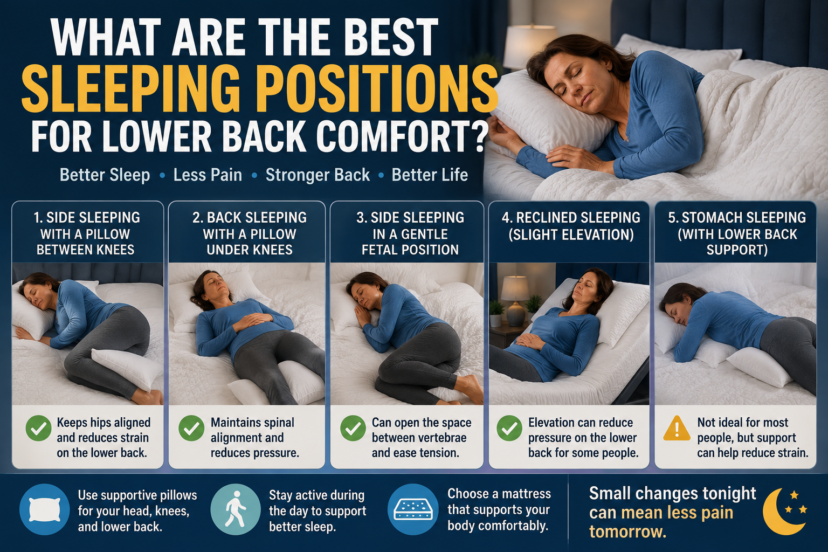
The best sleeping positions for lower back comfort are back sleeping with a pillow under your knees and side sleeping with a pillow between your knees. You climb into bed hoping your aching back will finally get a break, but finding a comfortable position can sometimes feel impossible. If you’re wondering what are the best sleeping positions for lower back comfort, the answer depends partly on your symptoms, preferred sleeping style, and what makes your body feel supported rather than strained.
Lower back discomfort can become more noticeable after hours of sitting, physical activity, muscle tension, or simply remaining in one sleeping position too long. Age-related joint changes and reduced strength may also make nighttime comfort more challenging.
Fortunately, you don’t necessarily need an expensive mattress or specialty sleep system. Small adjustments—such as placing a pillow between or underneath your knees—can make an ordinary sleeping position more comfortable. Combined with regular daytime movement, strength training, and healthy sleep habits, these changes may help you wake up feeling less stiff and ready to move.
⭐ Quick Answer: What Are The Best Sleeping Positions For Lower Back Comfort?
The best sleeping positions for lower back comfort are usually side sleeping with a pillow between the knees or back sleeping with a pillow beneath the knees. These positions may reduce uncomfortable twisting and help your hips and spine rest in a comfortable position. There is no single medically perfect sleeping posture, so choose the position that allows you to relax and doesn’t worsen your symptoms.
Key Takeaways
Most likely cause: Nighttime lower back discomfort commonly involves prolonged positioning, muscle or joint sensitivity, an uncomfortable sleep position, or a mattress and pillow setup that doesn’t suit your body.
Usually serious? Usually not. Many cases involve common mechanical back pain, although persistent, worsening, or unexplained nighttime pain deserves medical evaluation.
First thing to check: Notice whether your symptoms improve when you change positions or add pillow support beneath or between your knees.
Best solution: When considering what are the best sleeping positions for lower back comfort, prioritize a relaxed position that minimizes symptoms, use pillows strategically, and support your back with healthy daytime movement and strengthening.
🛏️ Why Sleeping Position Can Affect Lower Back Comfort
Your lower back doesn’t completely switch off when you sleep.
Your spine, hips, muscles, and connective tissues remain positioned for hours. If that position feels uncomfortable to already sensitive tissues, pain or stiffness may gradually become more noticeable.
Sleeping position is only one piece of the puzzle.
Your mattress, pillow height, daytime activity, muscle strength, previous injuries, arthritis, and the underlying cause of your pain can all influence how you feel overnight.
This is why there isn’t one perfect position for every person.
The practical goal is to find a position that allows your muscles to relax without noticeably increasing pain, numbness, tingling, or other symptoms.
😴 1. Side Sleeping With A Pillow Between Your Knees
Side sleeping is comfortable for many adults with lower back discomfort.
The key is preventing your upper leg from dropping excessively forward and rotating your pelvis while you sleep.
Try placing a pillow between your knees or thighs.
Keep your knees comfortably bent rather than pulling them tightly toward your chest. Your shoulders and hips should feel relaxed rather than forced into a rigid position.
A standard bed pillow may work perfectly well. You don’t necessarily need a specialized orthopedic knee pillow.
How To Set It Up
- Lie On Your Most Comfortable Side.
- Bend Your Knees Slightly.
- Place A Pillow Between Your Knees.
- Keep Your Head Comfortably Supported.
- Avoid Excessive Twisting Through Your Waist.
If one side increases pain, try the other.
Comfort should guide the adjustment.
🛌 2. Back Sleeping With A Pillow Under Your Knees
For some people asking what are the best sleeping positions for lower back comfort, lying on the back is the simplest answer.
Try placing one or two pillows beneath your knees.
Slightly bending the knees can change the position of your pelvis and may reduce tension through the lower back for some sleepers.
You can also experiment with a small towel roll for additional support if there is an uncomfortable gap beneath your lower back, but don’t force your spine into a particular curve.
The goal is relaxation.
If adding more pillows creates pressure or makes your symptoms worse, simplify your setup.
🌙 3. Side Sleeping In A Gentle Fetal Position
A loosely curled side position may feel comfortable for certain types of back pain.
The important word is gentle.
Don’t pull your knees aggressively toward your chest or curl yourself tightly into a ball. Excessive bending may become uncomfortable after several hours.
Instead, bend your hips and knees enough to feel relaxed.
This position may be particularly comfortable for some people who dislike lying completely flat.
If you experience radiating leg pain, numbness, or tingling, pay attention to whether curling forward improves or worsens those symptoms. Different back and nerve conditions can respond differently to spinal positions.
🧘 4. Reclined Sleeping May Help Some People
Some adults discover that lying completely flat isn’t comfortable.
A slightly reclined position may feel better.
An adjustable bed can provide this setup, but you don’t necessarily need to purchase one immediately. Some people experiment temporarily with a supportive reclining chair or carefully arranged wedge pillows.
Your hips and knees should remain comfortably supported, and you should be able to change positions safely.
Reclined sleeping isn’t a treatment for the underlying cause of back pain. Think of it as a comfort strategy while you work on the factors contributing to your symptoms.
⚠️ 5. Stomach Sleeping May Need Modification
Stomach sleeping is often criticized as automatically “bad” for your back, but sleep comfort isn’t that simple.
If you’ve comfortably slept on your stomach for years without problems, you don’t necessarily need to force yourself into another position.
However, stomach sleeping can feel uncomfortable for some people because it may increase the arch in the lower back and requires the head to remain turned.
If you prefer sleeping on your stomach, try placing a thin pillow underneath your lower abdomen or pelvis and using an appropriate pillow beneath your head.
If symptoms consistently increase in this position, side or back sleeping may be worth trying.
🧠 Does Your Spine Need To Be Perfectly Straight While Sleeping?
You may have heard that your spine must remain perfectly straight throughout the night.
That’s an oversimplification.
Your spine naturally has curves, and everyone has a different body shape. The goal isn’t to force your spine into a perfectly straight line.
Instead, focus on a position that feels supported and allows you to relax.
If you’re repeatedly waking because of pain or constantly shifting to escape discomfort, your current setup may need adjustment.
When exploring what are the best sleeping positions for lower back comfort, symptom response is often more useful than trying to achieve a textbook sleeping posture.
🛏️ How To Choose A Mattress For Lower Back Comfort
Mattress marketing can make it seem as though there is one ideal firmness for back pain.
Reality is more individual.
A mattress should feel supportive and comfortable enough that you can sleep without excessive pressure or sagging.
Research has suggested that medium-firm mattresses can work well for some people with nonspecific low back pain, but personal preference and body characteristics still matter.
Before spending thousands of dollars, consider whether your mattress is actually the problem.
Ask yourself:
- Does The Mattress Sag Noticeably?
- Do You Wake In A Deep Depression?
- Do You Sleep Better On Other Beds?
- Has The Mattress Become Uncomfortable Over Time?
- Does Changing Your Position Affect Symptoms More Than Changing Beds?
A mattress trial period can be valuable because comfort is difficult to judge after five minutes in a showroom.
💤 How To Choose The Right Pillow
Your head pillow matters too.
An excessively high or low pillow may leave your neck uncomfortable, particularly during side sleeping.
Side sleepers generally need enough pillow height to comfortably fill the space between the head and mattress. Back sleepers often need less height.
Pillows between or underneath the knees don’t need to be expensive.
Standard pillows, body pillows, or inexpensive knee pillows available from major U.S. retailers can all work. What matters is whether the pillow maintains a comfortable position throughout the night.
🚶 Your Daytime Habits Matter More Than You Think
Your nighttime position isn’t the only factor affecting morning back pain.
If you spend eight hours sitting at a desk and several more hours on the couch, your back and hips may already feel stiff before you enter the bedroom.
Regular movement can help.
Try:
- Taking Short Walking Breaks.
- Changing Positions Frequently.
- Walking After Dinner.
- Maintaining Regular Physical Activity.
- Gradually Strengthening Your Hips And Trunk.
- Avoiding Sudden Increases In Exercise.
Your back generally benefits from varied movement rather than spending most of the day in one position.
💪 Strengthening For Better Back Support
Strong muscles help you tolerate everyday physical demands.
You don’t need extreme core workouts.
Depending on your condition, a physical therapist may recommend exercises such as bridges, bird dogs, modified planks, sit-to-stands, hip strengthening, and resistance exercises.
The goal is to gradually increase your body’s ability to handle movement.
Strength training can be especially valuable as you get older because maintaining muscle supports mobility, balance, and independence.
Avoid assuming that every back problem requires the same exercises. If a movement repeatedly causes sharp or radiating pain, stop and seek appropriate guidance.
🌿 Natural Ways To Reduce Lower Back Discomfort Before Bed
Simple home strategies can sometimes make settling into your preferred sleeping position easier.
Take A Short Evening Walk
Several minutes of comfortable walking may help reduce stiffness after sitting through the evening.
Try A Warm Shower
Heat can temporarily soothe tight or aching muscles for some people.
Use A Heating Pad Carefully
A heating pad may provide temporary comfort. Follow the manufacturer’s safety instructions and don’t fall asleep while using an electric heating pad unless it is specifically designed and approved for that purpose.
Practice Gentle Mobility
Slow, comfortable hip and back movements may help you unwind before bed.
Avoid forcing stretches into pain.
Create A Consistent Sleep Routine
Pain and poor sleep can reinforce each other. Regular sleep and wake times, a dark bedroom, and reducing late-night stimulation may support better sleep quality.
🧍 How To Get Out Of Bed With Less Back Strain
How you get out of bed can matter when your back is particularly sensitive in the morning.
Instead of suddenly performing a sit-up from a flat position, try rolling onto your side first.
Then:
- Move Your Legs Toward The Edge Of The Bed.
- Use Your Arms To Help Push Your Upper Body Up.
- Sit Briefly If You Feel Stiff Or Lightheaded.
- Stand Using Your Legs And Arms As Needed.
- Walk Gently Before Attempting Deep Bending.
This technique isn’t mandatory for everyone, but it can make getting out of bed more comfortable during a painful episode.
👨⚕️ How Physical Therapy Can Help With Sleep-Related Back Pain
If you’ve experimented with different sleeping positions but still wake up hurting, the underlying problem may need more attention than another pillow.
A physical therapist can assess your strength, mobility, balance, functional movement, and activities that trigger or relieve your symptoms.
Treatment may include:
- Individualized Strengthening.
- Hip And Spine Mobility Exercises.
- Movement And Lifting Education.
- Activity Modification.
- Gradual Exercise Progression.
- A Personalized Home Program.
A therapist can also help determine whether your sleep position appears to be a significant trigger or whether daytime factors deserve greater attention.
🩺 When To See A Doctor About Lower Back Pain
Most uncomplicated lower back pain improves over time, but persistent or unusual symptoms shouldn’t be ignored.
Talk with a healthcare professional if pain continues for several weeks, repeatedly wakes you from sleep, keeps worsening, or significantly limits walking, work, sleep, or everyday activities.
Medical evaluation is also important if back pain occurs with unexplained fever or weight loss, follows significant trauma, or develops in someone with a history of cancer, serious infection, osteoporosis, or weakened immunity.
Seek urgent medical attention for:
- New Bladder Or Bowel Control Problems.
- Numbness Around The Groin Or Saddle Area.
- Rapidly Worsening Leg Weakness.
- Severe Symptoms After Major Trauma.
- Significant New Neurological Changes.
These symptoms require more than adjustments to your sleeping position.
❓ FAQs About Sleeping Positions For Lower Back Comfort
1. What Is The Best Position To Sleep In With Lower Back Pain?
Many people find either side sleeping with a pillow between the knees or back sleeping with a pillow beneath the knees comfortable. There isn’t one best position for everyone, so choose the setup that reduces your symptoms.
2. Is It Better To Sleep On Your Back Or Side With Lower Back Pain?
Either can work. Back sleeping may feel better with knee support, while side sleeping can be made more comfortable with a pillow between the knees. Your symptoms should guide the choice.
3. Is Sleeping On Your Stomach Bad For Lower Back Pain?
Not necessarily, but stomach sleeping can increase discomfort for some people. If you prefer this position, experiment with a thin pillow underneath your pelvis or lower abdomen.
4. Should I Put A Pillow Under My Lower Back While Sleeping?
Some people find a small towel or thin support comfortable, but excessive support may increase pressure. A pillow beneath the knees is often a simpler adjustment for back sleepers.
5. Why Does My Lower Back Hurt More When I Wake Up?
Prolonged positioning, muscle or joint stiffness, your mattress, sleep posture, arthritis, or an underlying back condition may contribute. Pain that persists or progressively worsens should be evaluated.
6. Can A Pillow Between My Knees Help Lower Back Pain?
It may. For side sleepers, a pillow between the knees can help prevent the upper leg from dropping forward and creating an uncomfortable rotation through the hips and lower back.
7. Can Changing My Sleeping Position Fix Chronic Back Pain?
Changing positions may reduce a nighttime trigger, but chronic back pain often involves multiple factors. Regular activity, appropriate strengthening, healthy sleep, and professional treatment when necessary may also be important.
🏡 Final Thoughts: Comfort Matters More Than A “Perfect” Sleeping Position
When asking what are the best sleeping positions for lower back comfort, remember that your body isn’t required to fit one universal sleeping rule.
Start with the simplest options.
Try sleeping on your side with a pillow between your knees or on your back with a pillow underneath them. Experiment with small changes rather than buying an entirely new sleep system immediately.
Then look beyond your bedroom.
Regular walking, strength training, movement breaks, healthy sleep habits, and gradual activity can support your back throughout the day and make nighttime comfort easier to achieve.
Give each reasonable adjustment enough time to judge whether it actually helps. Back pain often changes gradually, and recovery isn’t always a straight line.
The goal isn’t to keep your spine perfectly positioned for eight hours. It’s to find a comfortable setup that allows you to sleep, recover, and wake ready to keep moving.
Medical Disclaimer: This article is intended for general educational and informational purposes only. It isn’t a substitute for individualized medical advice, diagnosis, or treatment. Consult a physician, physical therapist, or other qualified healthcare professional for persistent, severe, or worsening back pain and before starting a new exercise, supplement, or treatment program. Seek urgent medical attention for significant neurological symptoms, loss of bladder or bowel control, major trauma, or other emergency symptoms.
Explore more:
- What Are The Best Healthy Habits For Mobility?
- Why Does My Back Pain Get Worse At The End Of The Day?
- How Can I Sit Comfortably With Lower Back Pain?