
Why Do Stairs Make My Knees Hurt More? 10 Common Reasons And How To Make Stairs Easier
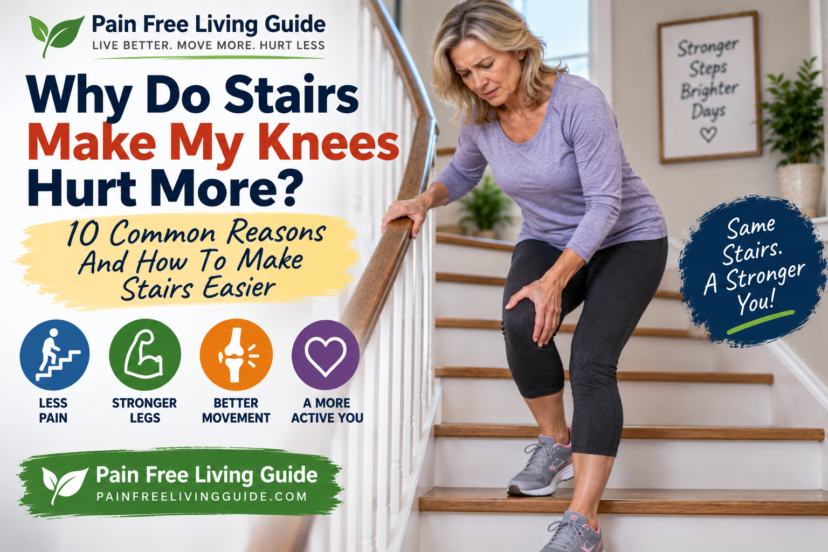
A staircase can quickly reveal knee discomfort you barely notice while walking on level ground. If you’re wondering why do stairs make my knees hurt more, one reason is simple: climbing and descending stairs generally ask more of your knees and surrounding muscles than ordinary walking. Your knees bend farther, your leg muscles work harder, and the forces around the knee change as you lift or lower your body.
For adults already living with knee pain, stiffness, arthritis, or reduced leg strength, those extra demands can turn an everyday staircase into a frustrating obstacle.
But avoiding every stair isn’t practical—and may not always be necessary. Your bedroom may be upstairs, your front door may have steps, or you may encounter stairs at work and while traveling.
The smarter goal is to understand what makes stairs uncomfortable and improve how your body handles them.
🪜 Quick Answer: Why Do Stairs Make My Knees Hurt More?
Stairs can make knee pain worse because your knees bend more and your leg muscles must work harder to lift or control your body. This can increase stress around the knee, particularly if you already have knee osteoarthritis, kneecap-related pain, weakness, stiffness, or an irritated joint. Slowing down, using the handrail, reducing heavy loads, and strengthening your hips and legs may make stairs more comfortable.
Key Takeaways
Most likely cause: Stairs require deeper knee bending and greater muscular effort than level walking, which can make an already painful or sensitive knee more noticeable.
Usually serious? Usually not by itself. Knee pain on stairs is common with several musculoskeletal conditions, but severe pain, major swelling, locking, instability, or symptoms following an injury should be evaluated.
First thing to check: Notice whether pain is worse going up or down, where the knee hurts, whether swelling is present, and whether weakness, rushing, or carrying heavy loads makes symptoms worse.
Best solution: If you’re wondering why do stairs make my knees hurt more, start by using the handrail, slowing your pace, reducing unnecessary loads, and gradually strengthening the muscles that support your knees.
🔍 Why Stairs Put Different Demands On Your Knees
Walking upstairs isn’t simply walking at an angle.
To reach the next step, your hip and knee bend, and your leg muscles generate force to raise your body against gravity.
Going downstairs creates a different challenge. Your muscles have to control your body as gravity pulls you downward.
Your kneecap, or patella, moves within a groove at the end of your thigh bone during knee bending and straightening. As knee flexion and muscular demand increase, forces around the patellofemoral joint can also increase.
This helps explain why someone can comfortably walk around a grocery store yet notice knee pain immediately on the stairs.
It doesn’t automatically mean every step is damaging your knee.
🦵 1. Your Knees Bend More On Stairs
Your knee goes through a greater range of motion during stair climbing than it typically does during ordinary level walking.
If your knee is already sensitive, that deeper bend may bring on symptoms.
You might notice aching around or behind the kneecap, stiffness within the joint, or discomfort that becomes progressively more noticeable over several flights.
Rather than immediately eliminating stairs, start by observing your symptoms.
Does discomfort begin with the first step?
Does it increase only after several flights?
Is going downstairs worse than going up?
Those details can help a healthcare professional or physical therapist understand the pattern.
🧩 2. Kneecap-Related Pain Can Become More Noticeable
Pain around or behind the kneecap is often called patellofemoral pain.
Activities involving repeated knee bending—such as squatting, running, prolonged sitting, and stair climbing—can aggravate symptoms in some people.
If you’re asking why stairs make your knees hurt more, and the discomfort is concentrated near the front of your knee, patellofemoral pain is one possible explanation.
However, knee pain shouldn’t be self-diagnosed based on location alone.
Several problems can cause similar symptoms, so persistent pain deserves appropriate evaluation.
🦴 3. Knee Osteoarthritis Can Make Stairs More Difficult
Knee osteoarthritis becomes more common with age and can cause pain, stiffness, swelling, and reduced function.
People with knee osteoarthritis may find stairs particularly challenging because of the combination of knee bending, muscular effort, and load.
However, an arthritis diagnosis doesn’t automatically mean you should stop using your knees.
Exercise is commonly an important component of managing knee osteoarthritis. Appropriate strengthening and aerobic activity can support physical function and help people remain active.
A physical therapist can help modify exercises if ordinary movements are currently too uncomfortable.
💪 4. Weak Thigh Muscles Can Make Every Step Harder
Your quadriceps—the large muscles at the front of your thighs—play a major role during stair climbing.
Going upstairs requires them to help straighten your knee and lift your body.
Going downstairs requires them to help control your descent.
If these muscles are weak or easily fatigued, stairs may feel much more demanding.
This can create a difficult cycle:
Knee Pain → Less Activity → Reduced Strength → Stairs Become Harder → More Avoidance.
Gradual strengthening can help interrupt this cycle.
You don’t necessarily need a gym. Simple sit-to-stand exercises can be a useful starting point for some adults.
🍑 5. Hip Strength Matters Too
Your knee isn’t working independently.
Muscles around your hips help control your pelvis and leg during walking, standing, and stair climbing.
This is why a physical therapist evaluating knee pain may test your hips as well as your knees.
Exercises such as bridges, side-stepping with appropriate resistance, sit-to-stands, and other hip-strengthening movements may be included depending on your individual needs.
Think of stair climbing as a whole-leg activity rather than a knee-only activity.
Building stronger legs can help make daily movement feel less demanding.
⬇️ 6. Going Downstairs May Hurt More Than Going Up
Many people notice that descending is particularly uncomfortable.
When going downstairs, your quadriceps must control your knee as your body lowers toward the next step.
This controlled lowering can be demanding.
You also need confidence and balance because you’re transferring your body weight downward while locating the next step.
If descending is painful, use the handrail and slow down.
Try to lower yourself with control rather than dropping heavily onto the next step.
If your knee repeatedly buckles or gives way, have it professionally evaluated rather than simply trying to strengthen through the problem yourself.
🐢 7. Rushing Can Make Stairs More Difficult
When your knees hurt, you may want to get the staircase over with quickly.
But rushing can reduce movement control.
Try slowing down enough to place your foot securely on each step.
Use the handrail when it improves comfort or stability.
You can think:
Step → Stabilize → Transfer Weight → Continue.
This doesn’t mean you need to climb stairs in slow motion forever.
It’s simply a practical way to make unavoidable stairs more manageable while you’re experiencing pain.
🛍️ 8. Carrying Extra Weight Makes The Task Harder
Carrying laundry, groceries, luggage, or packages increases the physical demands of stair climbing.
Bulky items may also block your view or prevent you from holding the handrail.
If stairs make your knees hurt more, avoid making the task unnecessarily difficult.
Break heavy loads into shorter trips.
Ask for help with large objects.
Keep one hand available for the railing whenever possible.
A lightweight backpack may work for some small items, but don’t overload it just to avoid making another trip.
Safety comes first.
👟 9. Footwear And Stair Safety Can Affect Comfort
Your shoes aren’t necessarily the cause of your knee pain, but stable, secure footwear can help you feel more confident on stairs.
Loose slippers or slippery socks may make you tense your body because you’re worried about slipping.
Also look at the staircase itself.
Make sure:
- Handrails Are Secure
- Steps Are Free Of Clutter
- Stair Edges Are Easy To See
- Lighting Is Adequate
- Surfaces Aren’t Slippery
- Loose Rugs Aren’t Creating A Hazard
These changes become increasingly important as we age because maintaining safe mobility helps support independence.
⏱️ 10. Fatigue Can Make Knee Pain More Noticeable
Your knees may tolerate stairs fairly well in the morning but feel significantly worse later.
That’s not necessarily unusual.
By evening, you may have spent hours walking, standing, working, shopping, cooking, or completing household tasks.
Your muscles can become tired, and your existing pain may become more noticeable.
Activity pacing can help.
Spread demanding tasks throughout your day and take short recovery breaks instead of completing every physical job consecutively.
Managing knee pain doesn’t mean becoming inactive. It means using your available physical capacity more strategically.
💪 Exercises That May Make Stairs Easier
If stairs are part of your daily life, improving the strength required for them is a practical long-term goal.
Depending on your condition and ability, exercises may include:
Sit-To-Stands
Stand from a stable chair and return slowly.
This strengthens your legs while practicing an everyday movement.
Mini Squats
Holding stable support if necessary, perform a small, comfortable knee bend and return to standing.
Step-Ups
When appropriate, low controlled step-ups can directly train the movement required to climb stairs.
Calf Raises
Rise onto your toes and slowly lower while holding support if needed.
Walking
Regular comfortable walking helps maintain general endurance and keeps you active between stair trips.
Don’t assume that pain means you need to exercise harder. Begin with a manageable level and gradually increase difficulty.
🌿 Simple Home Strategies For Sore Knees
When stairs make knee pain worse, temporary comfort strategies may help after a demanding day.
Some people prefer cold packs when a knee feels irritated or swollen, while others find gentle warmth comfortable for stiffness.
Protect your skin and limit exposure according to product instructions.
Gentle movement can also be useful. Sitting completely still for hours may leave some people feeling stiffer when they stand again.
If appropriate for you, alternate comfortable rest with light walking and movement.
Don’t rely on supplements as a substitute for evaluation, exercise, or other proven management strategies. Discuss supplements with your healthcare professional, particularly if you take prescription medications or have other medical conditions.
🩺 How Physical Therapy Can Help With Painful Stairs
Physical therapy can be especially useful when stairs repeatedly trigger your knee pain.
A physical therapist can evaluate your knee mobility, quadriceps strength, hip strength, balance, walking pattern, and how you actually climb and descend stairs.
Your treatment might include:
- Progressive Leg Strengthening
- Hip Strengthening
- Mobility Exercises
- Balance Training
- Step-Up And Step-Down Practice
- Activity Pacing
- Home Exercise
The objective isn’t simply reducing pain during an exercise session.
It’s making your real-world staircase easier to manage.
🚨 When To See A Doctor
Knee pain on stairs is common, but certain symptoms deserve medical evaluation.
Contact a healthcare professional if your pain is severe, persistent, progressively worsening, significantly limits walking, or isn’t improving with reasonable self-care.
Also seek evaluation if your knee becomes substantially swollen, red, or hot; repeatedly locks or gives way; you cannot comfortably bear weight; or symptoms began after a significant injury.
Urgent evaluation may be necessary after major trauma, a visibly deformed joint, inability to bear weight, or severe swelling accompanied by concerning symptoms.
Persistent knee pain shouldn’t simply be dismissed as “getting older.”
❓ Frequently Asked Questions
Why Do My Knees Hurt Going Up Stairs?
Climbing requires greater knee bending and muscular effort than level walking. Existing knee sensitivity, osteoarthritis, patellofemoral pain, stiffness, or muscle weakness may make that increased demand uncomfortable.
Why Do My Knees Hurt More Going Downstairs?
Your leg muscles must control your body as you lower yourself toward the next step. This can place substantial demand on the quadriceps and knee, making descending uncomfortable for some people.
Is Knee Pain On Stairs A Sign Of Arthritis?
It can occur with knee osteoarthritis, but arthritis isn’t the only possible cause. Patellofemoral pain and other knee problems can also cause stair-related symptoms.
Should I Avoid Stairs If My Knees Hurt?
Not automatically. Temporarily modifying an aggravating activity may help during a flare, but complete long-term avoidance can reduce strength and activity tolerance. Seek professional guidance when symptoms are persistent or severe.
How Can I Make Stairs Easier On My Knees?
Use the handrail, move at a controlled pace, avoid unnecessarily heavy loads, wear secure footwear, and gradually strengthen your legs and hips.
What Exercises Strengthen Knees For Stairs?
Depending on your condition, sit-to-stands, mini squats, step-ups, calf raises, walking, and hip-strengthening exercises may improve the physical abilities needed for stairs.
Can Weak Legs Cause Knee Pain On Stairs?
Weakness doesn’t explain every case of knee pain, but reduced quadriceps and hip strength can make stair climbing more demanding. Progressive strengthening may improve function and stair tolerance.
🌅 Conclusion: Build Stronger, More Comfortable Steps
If you’re asking why do stairs make my knees hurt more, remember that stairs simply ask more from your knees and surrounding muscles than ordinary level walking.
Your knees bend farther. Your muscles work harder. Going upstairs requires you to lift your body, while going downstairs requires controlled lowering.
When you’re already living with knee pain, those demands can expose weakness, stiffness, fatigue, or joint sensitivity.
The answer isn’t necessarily to remove stairs from your life.
Start with practical changes: use the handrail, slow down, carry less, keep your staircase safe, and avoid rushing when you’re tired.
Then work on your long-term capacity.
Gradually strengthen your thighs and hips. Keep walking and moving at a tolerable level. Consider physical therapy when stairs remain difficult.
Most importantly, give yourself time. Strength and movement confidence build gradually.
Small improvements can make climbing the stairs, walking around your home, shopping, traveling, and participating in everyday life easier—and help you maintain the mobility and independence that matter as you get older.
Medical Disclaimer: This article is for general educational and informational purposes only and isn’t a substitute for professional medical advice, diagnosis, or treatment. Knee pain can have many causes. Consult a qualified healthcare professional for persistent, severe, worsening, or unexplained symptoms and before beginning a new exercise, supplement, or treatment program.
 Explore more:
- Creating A Pain-Friendly Home: 15 Simple Adjustments
- Why Is My Back Pain Worse When I Am Tired?
- Recovery Takes Longer With Age: 9 Reasons

Comments are closed.