Hip Pain After Walking: 9 Common Reasons Your Hips Hurt And How To Find Relief
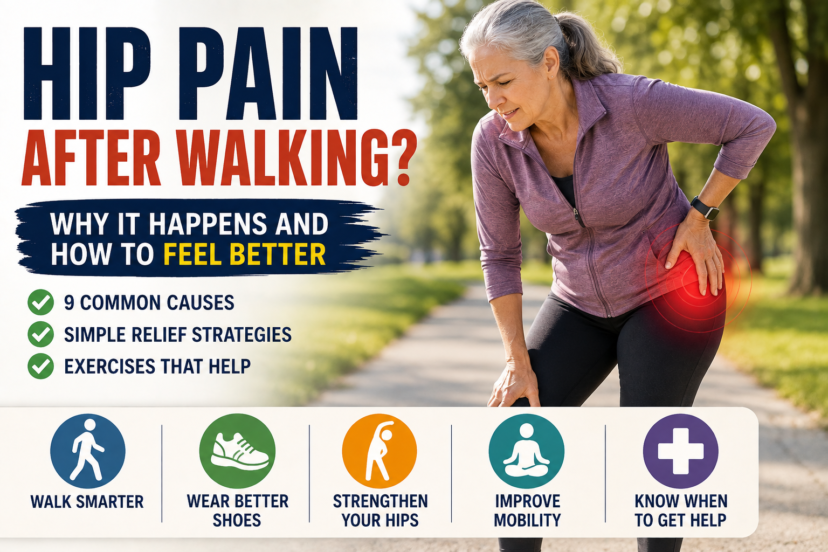
A long walk should leave you feeling energized—not wondering why your hips suddenly ache. Yet hip pain after walking is a common problem, particularly for adults who are increasing their activity, returning to exercise, or dealing with age-related changes in their muscles and joints. The discomfort may develop in the groin, outside of the hip, buttock, or upper thigh, and where it hurts can provide useful clues about the cause.
The encouraging news is that hip discomfort doesn’t automatically mean you need to stop walking. Sometimes the problem is simply too much distance too quickly, unsupportive footwear, muscle weakness, or insufficient recovery. Other cases may involve hip osteoarthritis, tendon problems, bursitis, or pain referred from the lower back.
Understanding the likely cause is the first step toward walking more comfortably, maintaining mobility, and staying active as you age.
⭐ Quick Answer: Hip Pain After Walking
Hip pain after walking is commonly associated with overuse, a sudden increase in walking distance, muscle or tendon irritation, hip osteoarthritis, greater trochanteric pain syndrome, or problems originating in the lower back. Reducing your walking distance temporarily, improving footwear, gradually strengthening your hips, and allowing adequate recovery may help. Persistent, severe, or worsening hip pain should be evaluated by a healthcare professional.
Key Takeaways
Most likely cause: Walking farther than your hips are currently conditioned for can overload muscles, tendons, and joints, particularly if you’ve recently increased your activity.
Usually serious? Usually not, but persistent or worsening pain can sometimes indicate arthritis, tendon problems, a stress injury, or another condition requiring medical evaluation.
First thing to check: Notice exactly where your hip pain after walking occurs, how far you can walk before it starts, whether you’ve recently increased your mileage, and whether your shoes are worn out.
Best solution: Temporarily reduce aggravating activity, maintain comfortable movement, strengthen the hip and surrounding muscles gradually, wear supportive footwear, and seek professional care if symptoms don’t improve.
🦴 Why Do Your Hips Hurt After Walking?
Your hips handle substantial forces every time you walk.
The hip joint connects the head of your thigh bone, or femur, with the pelvis. Muscles, tendons, ligaments, cartilage, and fluid-filled bursae work together to keep this joint stable while allowing your legs to move.
Walking farther than usual requires these tissues to repeat the same movements thousands of times.
If your muscles aren’t conditioned for the distance—or something changes your walking mechanics—certain tissues can become irritated.
Age can also play a role. Muscle mass and strength may gradually decline without regular resistance exercise, while osteoarthritis becomes more common as people get older.
That doesn’t mean hip pain is inevitable with aging.
Maintaining strength, healthy movement, and appropriate activity can help you continue walking comfortably for years.
🚶 9 Common Causes Of Hip Pain After Walking
Where your hip hurts and what triggers the symptoms can help narrow down possible explanations.
1. You Increased Your Walking Distance Too Quickly
One of the simplest causes is doing too much too soon.
Perhaps you normally walk one mile but suddenly completed a five-mile hike. Your cardiovascular system might handle it, but your hip muscles and tendons may not yet be conditioned for that workload.
This type of hip pain after walking often appears after unusually long or challenging activity.
Try temporarily reducing your distance and rebuilding gradually.
2. Hip Osteoarthritis
Osteoarthritis occurs when structures within a joint change over time, including changes involving cartilage and bone.
Hip osteoarthritis may cause pain around the groin, thigh, buttock, or hip. Some people notice stiffness after sitting or when getting out of bed.
Long walks may aggravate symptoms.
However, having arthritis doesn’t automatically mean you should stop exercising. Appropriate movement and strengthening are commonly important parts of osteoarthritis management.
3. Greater Trochanteric Pain Syndrome
Pain on the outside of the hip is often associated with greater trochanteric pain syndrome, which can involve the gluteal tendons and tissues around the greater trochanter.
The area may feel tender when you press it.
You might also experience discomfort while:
- Walking Long Distances
- Climbing Stairs
- Standing On One Leg
- Lying On The Painful Side
Treatment often involves activity modification and gradually strengthening the hip muscles rather than simply resting indefinitely.
4. Hip Flexor Irritation
Your hip flexors help lift your leg as you walk.
Long periods of sitting followed by a sudden increase in activity can sometimes leave these muscles feeling tight or irritated.
Pain may occur toward the front of the hip or groin.
Instead of aggressively stretching the area, combine comfortable mobility work with gradual strengthening and avoid movements that clearly worsen symptoms.
5. Gluteal Muscle Weakness
Your gluteal muscles stabilize your pelvis when you walk.
If these muscles aren’t strong enough for your activity level, other tissues may have to compensate.
This can contribute to poor walking mechanics and discomfort around the hip, thigh, or lower back.
Strengthening exercises such as bridges, sit-to-stands, and appropriately modified side-stepping exercises may help.
6. Worn-Out Or Unsupportive Shoes
Your shoes influence how forces travel through your feet, knees, hips, and lower back.
A shoe doesn’t have to look completely destroyed to have lost cushioning or support.
Look at the soles.
If they’re noticeably worn on one side, compressed, or uneven, replacing them may improve comfort.
When choosing walking shoes, prioritize fit and comfort rather than assuming the most expensive shoe is automatically the best.
7. Walking On Hills Or Uneven Surfaces
Walking on flat pavement and hiking a steep trail aren’t equivalent workouts.
Hills increase the demands placed on your hips and legs. Uneven terrain also requires additional stabilization.
If hip pain after walking appears mainly after hiking or hill walking, temporarily switch to flatter routes.
You can gradually reintroduce inclines as your strength and conditioning improve.
8. Pain Referred From Your Lower Back
Not all pain felt near the hip actually originates in the hip joint.
Problems involving the lumbar spine can sometimes cause pain that travels into the buttock, hip, or leg.
Symptoms such as numbness, tingling, burning, or pain traveling farther down the leg can be clues that nerves may be involved.
A healthcare professional or physical therapist can help determine whether your symptoms originate primarily from the hip or spine.
9. Stress Fracture Or Other Less Common Problems
Stress fractures are less common than muscle or tendon irritation but shouldn’t be ignored.
Repeated loading can occasionally cause small bone injuries, particularly in people with osteoporosis or other risk factors.
Pain that becomes progressively worse with weight-bearing, causes limping, or persists even after reducing activity deserves medical evaluation.
🧭 Where Your Hip Hurts Can Provide A Clue
Pain location isn’t enough to diagnose a condition, but it can help guide the conversation with your doctor or physical therapist.
Front Of Hip Or Groin: May be associated with the hip joint, osteoarthritis, hip flexors, or other structures.
Outside Of Hip: Frequently associated with gluteal tendon problems or greater trochanteric pain syndrome.
Buttock Or Back Of Hip: May involve muscles, the lower back, sacroiliac region, or referred pain.
Pain Traveling Down The Leg: May suggest irritation involving nerves or the lower back, particularly when accompanied by tingling or numbness.
Avoid trying to diagnose yourself from pain location alone.
Several conditions can produce overlapping symptoms.
🏠 How To Relieve Hip Pain After Walking At Home
For mild discomfort following an unusually long walk, simple changes may be enough.
Temporarily Reduce Your Distance
You don’t necessarily need to stop walking completely.
If three miles causes pain but one mile feels comfortable, temporarily walk the shorter distance.
You could also divide your activity into two shorter walks.
Use Heat For Stiffness
A warm shower or heating pad may temporarily help relax stiff muscles.
Apply comfortable warmth for around 15–20 minutes, protecting your skin from excessive heat.
Try Cold For Temporary Relief
Some people prefer a wrapped cold pack after activity when an area feels particularly irritated.
Never apply ice directly to your skin.
Keep Moving Gently
Complete inactivity can sometimes make stiffness worse.
Comfortable walking around the house and gentle range-of-motion movements may feel better than spending the entire day sitting.
💪 Strengthen Your Hips For More Comfortable Walking
If your goal is walking farther, don’t focus exclusively on walking.
Strength training can help your muscles tolerate the forces involved.
Useful exercises may include:
- Sit-To-Stands
- Glute Bridges
- Side Steps
- Step-Ups
- Calf Raises
- Supported Single-Leg Balance
Start with exercises that feel comfortable and use a stable counter or chair for support when needed.
Two or three short strengthening sessions per week may be easier to maintain than one exhausting workout.
A physical therapist can modify exercises if arthritis, previous surgery, balance problems, or chronic pain makes standard movements difficult.
🧘 Should You Stretch A Painful Hip?
Stretching can feel helpful when muscles are stiff, but more stretching isn’t always better.
Aggressively forcing your hip into uncomfortable positions can aggravate irritated tissues.
Instead, use gentle movements within a comfortable range.
Hold easy stretches without bouncing and stop if you experience sharp or increasing pain.
Long-term improvement often requires a combination of mobility and strength rather than stretching alone.
👟 Improve Your Walking Technique And Posture
You don’t need a perfect walking style, but a few simple habits can reduce unnecessary strain.
Try to:
- Walk With A Comfortable Natural Stride
- Keep Your Shoulders Relaxed
- Look Ahead Rather Than Constantly Down
- Avoid Deliberately Taking Very Long Steps
- Allow Your Arms To Swing Naturally
- Slow Down If Your Form Changes As You Tire
If you begin limping during longer walks, that’s a useful sign that you’ve probably exceeded your current comfortable distance.
Instead of pushing through another mile, finish the walk and adjust your next session.
📈 Increase Your Walking Distance Gradually
Your body needs time to adapt.
Rather than doubling your distance because you feel good one morning, make small changes and observe your response.
For example:
If 20 minutes is comfortable, maintain that distance for several walks.
Then try 22–25 minutes.
If your hip remains comfortable during the walk and afterward, gradually continue building.
You don’t need to follow a rigid percentage rule. Your symptoms, recovery, terrain, pace, and health status matter.
Consistency beats rapid progression.
🩺 How Physical Therapy Can Help Hip Pain
Physical therapy can be particularly useful when hip pain after walking repeatedly limits your activity.
A physical therapist can evaluate:
- Hip Strength
- Range Of Motion
- Balance
- Walking Mechanics
- Lower-Body Strength
- Functional Movements
- Activity Tolerance
Treatment may include progressive strengthening, mobility exercises, balance training, gait education, and strategies for safely increasing your walking distance.
The goal isn’t merely reducing today’s pain.
It’s helping your body become more capable of handling tomorrow’s activities.
🥗 What About Supplements For Hip And Joint Pain?
Glucosamine, chondroitin, turmeric or curcumin, omega-3 fatty acids, and vitamin D are commonly marketed in the U.S. for joint or musculoskeletal health.
Evidence for pain relief varies considerably between products and conditions.
Supplements should not replace appropriate exercise, medical evaluation, physical therapy, sleep, or nutritious food.
They may also interact with medications.
Speak with your doctor or pharmacist before regularly using supplements for hip pain, particularly if you take prescription medications.
🚨 When To See A Doctor For Hip Pain After Walking
Make an appointment with a healthcare professional if your pain repeatedly returns, lasts for several weeks, is progressively worsening, or prevents you from performing normal activities.
Seek more urgent medical care for symptoms such as:
- Severe Pain After A Fall
- Inability To Bear Weight
- Sudden Significant Swelling
- A Hot Or Red Joint
- Fever With Hip Pain
- New Significant Weakness Or Numbness
- Severe Night Pain
- Unexplained Weight Loss
- Progressive Pain Despite Rest
You should also consider medical evaluation if you have osteoporosis or other risk factors for fracture and develop new pain while walking.
❓ FAQs About Hip Pain After Walking
Why Do My Hips Hurt After Walking A Long Distance?
Common reasons include doing more activity than you’re conditioned for, hip osteoarthritis, gluteal tendon irritation, muscle weakness, poor footwear, or problems originating in the lower back.
Is It Okay To Keep Walking With Hip Pain?
It depends on the cause and severity. Mild discomfort may improve by shortening your walks and gradually rebuilding activity. Severe, worsening, or persistent pain should be medically evaluated.
How Do I Stop My Hips From Hurting When I Walk?
Start by reducing aggravating distances, checking your footwear, choosing flatter routes, and gradually strengthening your hips and legs. Physical therapy can help if the problem continues.
Does Hip Arthritis Hurt More After Walking?
Hip osteoarthritis can cause discomfort or stiffness during or after longer periods of activity. Appropriate exercise can still be beneficial, although your routine may need to be modified.
Why Does The Outside Of My Hip Hurt After Walking?
Pain on the outside of the hip may be associated with greater trochanteric pain syndrome, which often involves the gluteal tendons and surrounding tissues. A professional evaluation can confirm the cause.
Should I Rest Or Exercise With Hip Pain?
Some temporary reduction in aggravating activity may help, but complete inactivity isn’t always necessary. Comfortable movement and progressive strengthening are often useful once serious causes have been ruled out.
What Is The Best Exercise For Hip Pain From Walking?
There isn’t one universal exercise. Bridges, sit-to-stands, side-stepping, step-ups, and other progressive hip-strengthening exercises may help depending on the cause. A physical therapist can determine which movements are appropriate for you.
🌟 Final Thoughts: Keep Walking, But Listen To Your Hips
Experiencing hip pain after walking doesn’t automatically mean you have to give up one of the simplest and most beneficial forms of exercise.
Your body may simply need a more gradual approach.
Shorten your walks temporarily. Check your shoes. Choose flatter terrain. Strengthen your hips and legs. Allow adequate recovery between demanding activities.
Then gradually build again.
If symptoms persist or become worse, get the problem evaluated rather than repeatedly pushing through it.
Healthy aging isn’t about ignoring discomfort. It’s about understanding what your body needs and making smart adjustments that allow you to remain active.
With consistency, patience, and appropriate care, many people can improve their walking tolerance and continue enjoying an active, independent lifestyle.
Medical Disclaimer: This article is provided for educational and informational purposes only and is not intended to diagnose, treat, cure, or prevent any medical condition. It does not replace personalized advice from a physician, physical therapist, or other qualified healthcare professional. Seek professional medical advice for persistent, severe, unexplained, or worsening hip pain, and before making significant changes to your exercise routine, medications, or supplements.
 Explore more: